
NEAR spent the past several months rebuilding IronClaw from the ground up. The team concluded that the properties an AI assistant needs most are architectural, the kind that have to be designed in from the start. IronClaw 1.0 is the result of that decision.
IronClaw is NEAR's agent harness, the software layer that sits between a raw AI model and a working product. It decides what the model is allowed to act on and governs its permissions and memory, keeping its behavior secure and consistent enough to be trusted to run a piece of a business. The earlier version of IronClaw established the idea and showed the team what production use demands. IronClaw 1.0 is NEAR earning the number.
The 1.0 release rebuilds that layer around a single guard checkpoint that every action has to pass through. Memory now persists across sessions, and continuous checkpointing means an interrupted task picks up where it stopped. The result already shows up on the leaderboard. On OfficeQA, a benchmark built by Databricks that tests grounded reasoning over dense enterprise documents, IronClaw makes roughly 12% fewer errors than Hermes and 15% fewer than OpenClaw, the two products it competes with most directly. IronClaw is evidence that a shift I've been tracking for months is now showing up in shipped products.
At SVRN, a digital asset treasury company built around NEAR, our thesis rests on a specific bet: that NEAR is building in the part of the AI stack where we believe value will accrue, and that we're making that bet before the rest of the market catches up.
Mapping the AI stack: where AI infrastructure value accrues
Chamath Palihapitiya, a former Facebook executive who is now founder and CEO of Social Capital, a Palo Alto-based investment firm, recently laid out a way to think about that stack: land and power, silicon, cloud, models, harnesses, applications, six markets with six different economics. He's out on silicon and cautious on clouds. His conviction, and mine, is that harnesses are where the action is, because a harness is what lets an enterprise own its proprietary context, its data, workflows, evals, and business rules, what Palantir's co-founder and CEO Alex Karp calls an enterprise's "alpha."
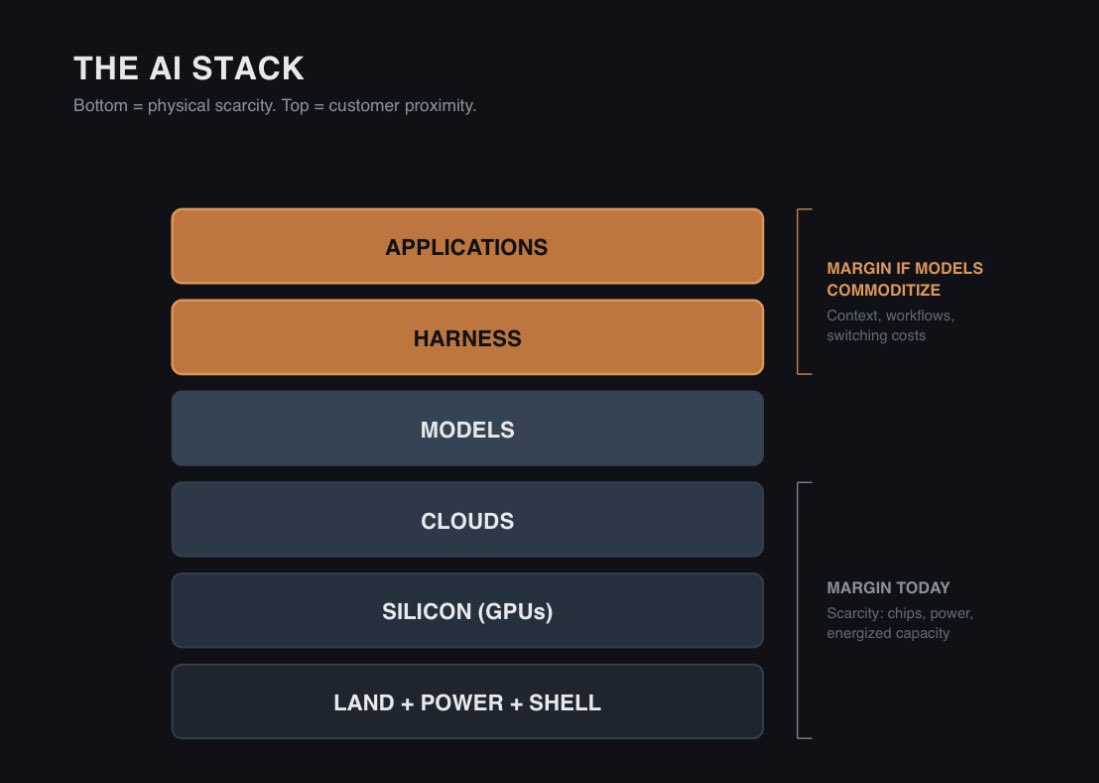
Most of the industry is still debating models. I think the more interesting conversation is only beginning to emerge one layer higher in the stack, and almost nobody outside a small circle of investors and infrastructure builders is having it yet. There's a history behind that. Andreessen Horowitz made an early version of this argument back in 2023, when it noted that infrastructure vendors were capturing most of the dollars flowing through the generative AI stack while no layer, model or application, had a clearly durable moat. Three years later, I think we're starting to see that layer emerge more clearly. We've spent the past several months peeling back these layers of the AI stack specifically to get ahead of that question, coming to market with a point of view before the broader AI infrastructure crowd catches up to it.
The timeline is what makes this urgent. Frontier models will continue to improve. By late 2025, open-weight models already accounted for roughly one-third of all token volume routed through OpenRouter, one of the clearest real-world indicators of developer adoption. As enterprises move beyond pilots and into production, the question becomes whether the model can be trusted with the business. That's the point where infrastructure begins to matter more than incremental gains in model performance. IronClaw 1.0 arrives at exactly that moment.
Why value accrues to secure AI agent harnesses
Harnesses will capture key value in the AI stack. That view cuts against where most of the industry conversation still sits, and it's the opportunity I see for NEAR in this category.
A harness accumulates a specific, compounding record of how one organization works: its eval history, its failure patterns, its permission structure, its institutional memory. Every week that record grows, and the cost of leaving grows with it. Swap the model underneath a well-built harness and the enterprise keeps everything it has already taught the system. Replacing the harness means starting over. That asymmetry is the whole investment case: switching costs in AI infrastructure will come from the layer that owns the enterprise's context, which gets more valuable the longer it runs, while the intelligence itself commoditizes in real time. The frontier labs see this and are pushing hard down the same path to increase the stickiness of their proprietary models.
This is also why I think the comparison to traditional SaaS moats undersells the opportunity. A SaaS product locks in a customer through workflow habit and switching friction, and the software stays the same product for as long as they use it. A harness gets smarter with use. The tasks it runs and the corrections humans make become part of the enterprise's own accumulated context, which means the moat compounds through usage itself. That's a business with real, compounding unit economics behind it, and it's why I think this layer is underpriced relative to where the market's attention still sits.
There's a reason this matters specifically to a treasury company. Most technology moats decay: the cost of serving a customer stays roughly flat while the differentiation that justified the premium erodes as competitors catch up. A harness inverts that curve. The cost of running it stays roughly flat too, and the value it holds, the accumulated context, keeps climbing for as long as the enterprise keeps using it. That gap between flat cost and rising value is exactly the kind of spread a long-duration capital allocator should want exposure to. We evaluate IronClaw as a claim on a widening spread, the kind of asset a treasury strategy is built to hold.
Researchers at MBZUAI's VILA Lab recently analyzed the architecture of Claude Code and concluded that the overwhelming majority of its engineering complexity lies in the harness surrounding the model: permissions, context management, tool routing, memory, and recovery systems. That reinforces what I think the market is only beginning to appreciate. As models converge, the infrastructure around them becomes increasingly important.
Palantir is the clearest commercial example of this pattern, and it predates this AI cycle by a decade. Palantir wins because it built the layer that turns a company's operational reality, its entities, relationships, rules, and history, into something software and agents can act on correctly. UBS reached a similar conclusion from the buy side in April 2026, telling clients that Palantir's ontology layer has proven out as a genuine moat with low likelihood of disruption from any given model generation. The pattern generalizes past Palantir: the durable asset is the governed context wrapped around the intelligence.
IronClaw is NEAR's entry into that same layer of the AI stack, applying similar principles to a much broader enterprise market than Palantir has historically served.
IronClaw 1.0 vs. Hermes and OpenClaw: why usability wins the agent harness market
Hermes matters to this story for a specific reason: it proved that enterprises adopt agent harnesses the moment the product is usable day to day. IronClaw 1.0 is NEAR's play for that demand, and the benchmark numbers suggest it's ready, with a cleaner architecture and fewer errors against the dense documents enterprises run on.
We've spent the past several months studying where value accrues across the AI stack because those conclusions are what inform where we believe capital should be deployed. SVRN's treasury strategy is built around NEAR for that reason, as a bet that NEAR is building toward the layer of the stack we believe holds the durable economics.
My view is that AI is entering the phase where it reveals which layer captures the durable value. IronClaw 1.0 is one reason I believe NEAR is building in the right part of it.
■ overview
August 5, 2026
IronClaw 1.0 marks the moment AI value shifts from models to harnesses, and why SVRN's NEAR treasury thesis is built on that layer of the stack.

key points
- IronClaw 1.0 rebuilds NEAR's agent harness around a single guard checkpoint and memory that persists across sessions. On Databricks' OfficeQA benchmark it makes roughly 12% fewer errors than Hermes and 15% fewer than OpenClaw.
- As models commoditize, durable value shifts to the harness: the layer that owns an enterprise's proprietary context and gets more valuable the longer it runs.
- SVRN's NEAR treasury strategy is a bet on that layer of the stack, not on any single product release.